
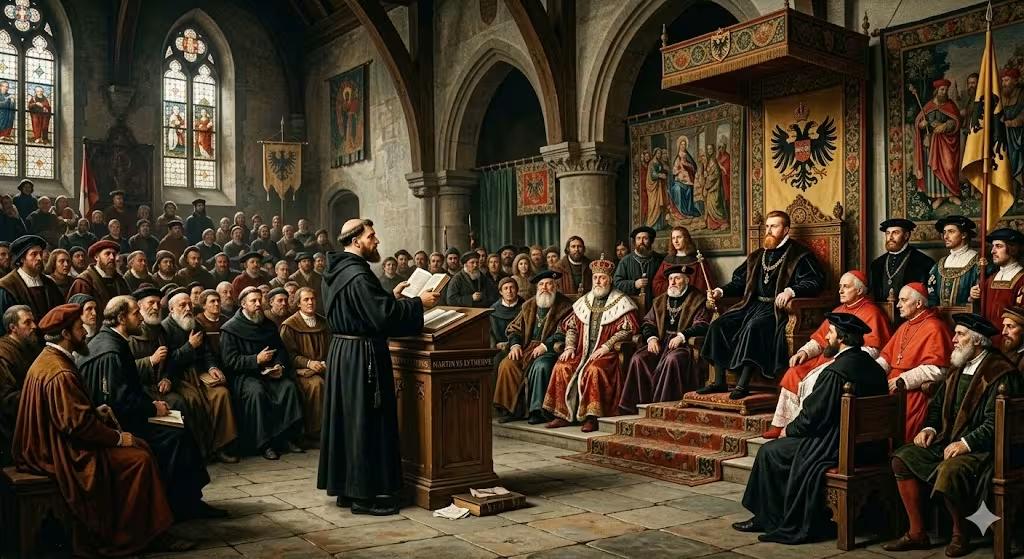
Jag håller på att kämpa mig igenom den första delen av tre i Martin Brecht:s serie om Martin Luther. Det är tre tegelstenar om runt 600 sidor var. Brecht är nog så detaljerad och omfattande som du kan hitta om Luther, men det gör också texten jobbig att ta sig igenom.
Hur som helst, härom kvällen läste jag det här:
Then Luther explains what he means by “Christendom.” Here he avoids using the expression “church” (Kirche). But what he was really offering was an elaboration of his new understanding of the church. Christendom is a spiritual community of faith, which, in spite of earthly divisions, is bound together like no kingdom of this world, and therefore is not bound to Rome either. External unity under Rome constitutes neither Christendom nor heresy. Christians take their name from Christ their head, and in him all are equal. Thus the hierarchy is called into question. In the Scriptures, Christendom really means a spiritual communion. In addition, it is also used outside the Scriptures to identify the external worshipping assembly. Thus one must distinguish between an essential, spiritual, and internal Christen one must distinguish between an essential, spiritual, and internal Christendom and a man-made, external, physical Christendom. It is not that Luther wants to separate the two, for they belong together like soul and body. He was never a spiritualist in his concept of the church. External Christendom is was never a spiritualist in his concept of the church. External Christendom is held together by offices and law. In it there are true Christians, but alongside them are also those without faith, who do not belong to true Christendom. Spiritual Christendom cannot have an external head. It is only Christ their Spiritual Christendom cannot have an external head. It is only Christ their head who can give his members his will, faith, love, and hope, not the pope, who therefore can also not be the vicar of Christ. Just like Peter, the officeholders are nothing but messengers of Christ, essentially all equal, even though in the external church one is above the other. The marks of the spiritual church are the gospel, baptism, and the Lord’s Supper. (Martin Brecht, Martin Luther: His road to reformation 1483-1521, s.345)
Det fångade mitt intresse för jag har tidigare läst om Luthers syn på kyrkan, men det här är mer detaljerat än något annat jag läst. Så jag tittade i Luther’s Works, del 39, som Brecht hänvisar till. Här är några utdrag ur Luther:s On the papacy in Rome against the most celebrated romanist in Leipzig.
That is why I first have to explain to this crude mind and to others who have been seduced by him what Christendom and head of Christendom mean. But I have to speak bluntly and use the same words they have employed in their own wild reasoning. (s.65)
The first way, according to Scripture, is that Christendom means an assembly of all the people on earth who believe in Christ, as we pray in the Creed, “I believe in the Holy Spirit, the communion of saints.” This community or assembly means all those who live in true faith, hope, and love. Thus the essence, life, and nature of Christendom is not a physical assembly, but an assembly of hearts in one faith, as St. Paul says in Ephesians 4 [:5], “One baptism, one faith, one Lord.” Accordingly, regardless of whether a thousand miles separates them physically, they are still called one assembly in spirit, as long as each one preaches, believes, hopes, loves, and lives like the other. (s.65)
This unity alone is sufficient to create Christendom, and without it, no unity—be it that of city, time, persons, work, or whatever else it may be—can create Christendom. (s.65)
This indicates that all of Christendom has no other head than Christ, even on earth, because it has no other name than the one derived from Chris. (s.68)
It follows further that, although man consists of two natures, body and soul, he is not counted as a member of Christendom according to his body, but according to his soul, indeed, according to his faith. (s.68)
Beyond that, there is a second way of speaking about Christendom. According to this, Christendom is called an assembly in a house, or in a parish, a bishopric, an archbishopric, or a papacy To this assembly belong external forms such as singing, reading, and the vestments of the mass. Here, above all, bishops, priests, and members of religious orders are called the “spiritual estate”—not because of faith, which they might not have, but because they are blessed with external anointing, wear crowns and special vestments, say special prayers, do special works, hold mass, stand in the choir, and seem to perform all such external worship. Although the little words “spiritual” or “church” are violated here when they are applied to such externals, since they refer only to the faith which makes true priests and Christians in the soul, this manner of speech has spread everywhere—to the not unimportant seduction and error of many souls who think such external glitter is the spiritual and true estate of Christendom or of the church. (s.69-70)
There is not a single letter in Holy Scripture saying that such a church, where it is by itself, is instituted by God. (s.70)
Canon and human laws do call such externals “church” or “Christendom.” But that is not the point right now. Therefore, for the sake of better understanding and brevity, we shall call the two churches by two distinct names. The first, which is natural, basic, essential, and true, we shall call spiritual, internal Christendom.” The second, which is man-made and external, we shall call “physical, external Christendom.” (s.70)
This Christendom is ruled by canon law and by prelates within Christendom. Included in it are all popes, cardinals, bishops, prelates, priests, monks, nuns, and all those who are regarded as Christians according to externals, no matter whether they are true and real Christians or not. For, although such a community does not make a true Christian—all the estates mentioned may continue to exist without faith—it never really exists without some people who are also true Christians, just as the body does not keep the soul alive, but the soul does exist in the body as well as without the body. But those who are in the second community without
faith and outside the first community, are dead before God; they are hypocrites and are merely like images of true Christendom. Israel has therefore been a figure of the spiritual people assembled in faith. (s.70-71)
According to the third way of speaking, it is not Christendom that is called the church, but rather the houses that are built for worship. (s.71)
Now let us consider the head of Christendom. From all this it follows that the first Christendom, which alone is the true church, may not and cannot have an earthly head. It may be ruled by no one on earth, neither bishop nor pope. Here only Christ in heaven is the head and he rules alone. This is proven, first of all, in this way. How can a man rule something he neither knows nor recognizes? (s.71)
Comments